
At 8:46 a.m. on February 28, 1975, a commuter train ran past the platform at Moorgate and struck the end of the tunnel. It killed 43 people and injured 74. Crews worked underground until late that night to free the last survivor. A stone in Finsbury Square and a plaque at the station remember the people on that train. (London Fire Brigade, 2025 remembrance) (London Remembers, Finsbury Square) (London Remembers, Moor Place)
Explore the story and records
The front of the train
Javier Gonzalez was 20 and studying economics at City of London Polytechnic. His first lecture was at 10:30, but he had decided to go in early. He told an interviewer in 2015 that he picked the front carriage because it was closest to the escalator at Moorgate. He had a newspaper open when the train shuddered. (Gonzalez interview, interview published 23 Feb. 2015)
“I knew the escalator at Moorgate was at the front of the train”
Gonzalez remembered looking up at the woman sitting opposite him. Then the lights went out. (Gonzalez interview)
The train had six carriages of 1938 Tube Stock. It ran from Drayton Park through Old Street and was due to stop at platform 9 at Moorgate. (McNaughton, official inquiry, paras. 7, 92–93)
This was then a London Underground service on what is now the Northern City Line. The railway and its signalling have changed substantially since 1975. (Willson, RSSB, historical and modern context)
Beyond the stopping point
The train passed the end of the platform and ran into the short tunnel beyond it. The front carriages crumpled together. From the platform, crews could see only part of the wreckage. (Fisher, incident-command account, pp. 14–16)
Chief Inspector Brian Fisher, the police incident officer, later described the misleadingly small first message to ambulance control: (Fisher, incident-command account, p. 14)
“Send an ambulance to Moorgate Station, a train driver has been injured”
Ambulances arrived at 8:54 a.m. Firefighters followed at 8:58. The last survivor was freed at 10:05 that night. (McNaughton, official inquiry, p. 1)
Responders had to get onto the platform and into the wreckage before they knew how many people needed help. Radios were unreliable underground. Crews used field telephones to reach the surface. (Fisher, incident-command account, pp. 15–17)
Working in the dark
Firefighter Steve Gleeson carried cutting and spreading equipment down the stairs as other crews helped people up. He remembered squeezing through a gap beside the train. The London Fire Brigade put the heat down there at about 33°C (91°F). (London Fire Brigade, rescue accounts, Steve Gleeson’s recollections)
“None of the crews working down there wanted to leave.”
Fresh crews relieved the ones who had been at it for hours. Frank Nice helped free police officer Margaret Liles, 19, and Jeffrey Benton, 27, near the front. Doctors had to amputate Liles’s trapped foot. Nice remembered being there with her during the procedure and spoke of the courage of both passengers. (London Fire Brigade, rescue accounts, Frank Nice’s recollections)
Doctors treated people while they were still trapped. In the report they wrote afterward, the medical teams stressed how much it helped to have anaesthetic equipment at the scene and a way to reach the hospitals that were taking patients. (Medical Staff, response report, abstract and pp. 727–729)
Some people died after reaching hospital. A later medical review looked at how crush injuries and chest trauma were treated after people came out of the wreckage. (Medical Staff, clinical review, summary and pp. 729–731)
The driver’s body was recovered on March 4. Crews finished clearing the wreckage on March 6. Normal service resumed on March 10. (McNaughton, official inquiry, p. 1)
The people on the train
Jeffrey David Benton worked as a jobber at the London Stock Exchange. He was Alan and Thelma Benton’s eldest child. His father cut cloth for a tailor. Jeffrey married Valerie Grimes in 1972. He was 27 when he died on March 26, almost a month after the crash. (Behan, Jeffrey Benton, biographical entry)
Bernard “Bernie” Marks, 68, had been an East End policeman during the Blitz. His son Laurence remembered his father taking him to Arsenal matches when he was a boy. Laurence was sent to cover the crash as a young freelance reporter and only then learned his father was on the train. (Gruner, Laurence Marks interview, family account)
Laurence kept investigating the crash and later helped write a radio drama about it. (Gruner, Laurence Marks interview)
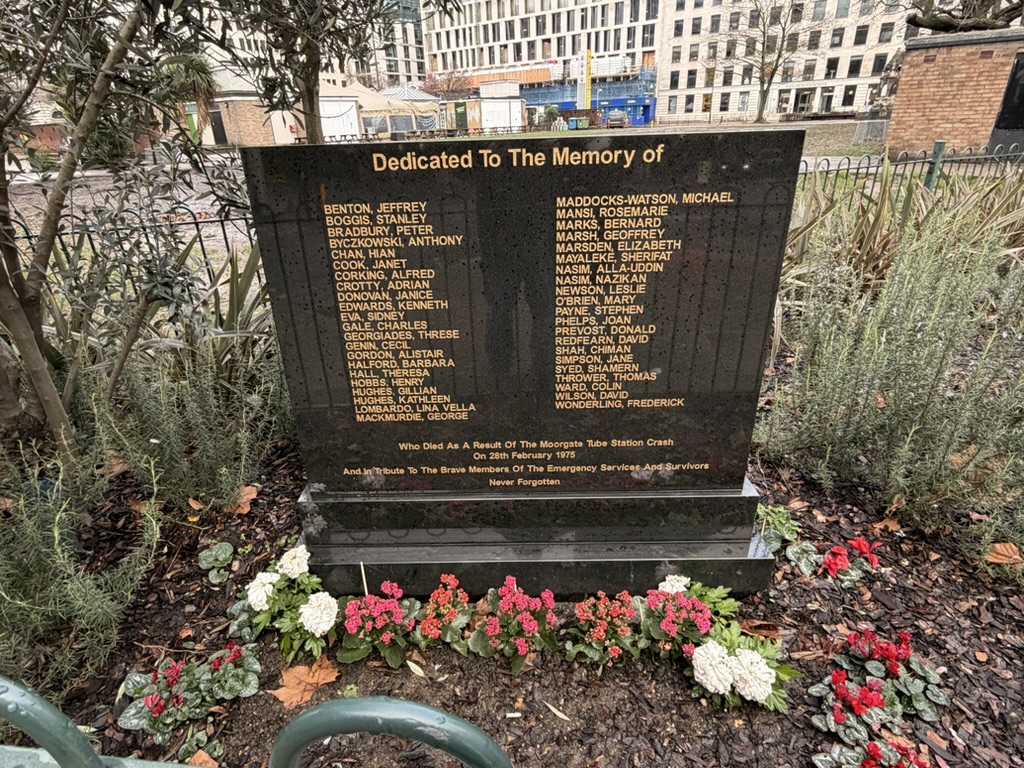
Margaret Liles and Javier Gonzalez survived. The Finsbury Square stone pays tribute to them and the other survivors, as well as to the responders. (London Fire Brigade, rescue accounts) (Our memorial photograph, inscription)
What the investigation established
Transport Minister Frederick Mulley announced a public inquiry in the House of Commons on March 3, while casualty figures were still provisional. (Mulley, Hansard, cols. 1041–1047)
Lt Col I. K. A. McNaughton’s report, published March 4, 1976, cleared the train, track, and signalling of faults that contributed to the crash. It found that driver Leslie Newson had failed to stop. The inquiry could not determine why. (McNaughton, official inquiry, para. 104)
Witnesses remembered seeing Newson upright and looking ahead. The controls showed power was still being applied shortly before impact. The evidence gave investigators little to use in deciding whether he had taken ill or acted deliberately. (Willson, RSSB)
The inquiry found that decomposition could explain the alcohol reading after his death. Investigators ruled alcohol out as a significant cause. (McNaughton, official inquiry, paras. 99–100)
The report gives a clear account of how the train came into the tunnel. What happened to Newson in those last moments remains unanswered.
Stopping the train when the driver did not
The rail safety board traces Moorgate Control to the crash. London Underground called its version Trains Entering Terminal Stations. It was designed to intervene automatically if a train came into a terminal too quickly. (Willson, RSSB)
If the driver did not slow down, the new system could apply the brakes before the train reached the end of the line.
The Northern City Line changed again in May 2025. Network Rail removed the traditional signals and switched to the European Train Control System, which sends signals into the driver’s cab. (Network Rail, May 2025, 19 May 2025 announcement)
The approach
Train speed must be controlled before the end of the line.
The stopping point
The driver’s normal stopping action belongs at the platform.
Independent protection
Automatic supervision adds a safeguard when the required action is not made.
The Finsbury Square stone and the station plaque
On July 28, 2013, a memorial stone was unveiled in the southwest corner of Finsbury Square after a campaign associated with historian Richard Jones. It lists all 43 people who died and pays tribute to the emergency services and survivors. In our photo, flowers rest at its base. (London Remembers, Finsbury Square) (Our memorial photograph)
The station memorial was unveiled on Moor Place on February 28, 2014. It remembers the 43 together. (London Remembers, Moor Place)
London Stone Conservation cut the station plaque’s letters by hand into Welsh slate. The lettering uses Johnston, the typeface you see on Underground signs. (London Stone Conservation, commission and materials)
On February 28, 2025, firefighters, transport staff, survivors, and families gathered on Moor Place. They read the names, stood in silence, and laid flowers 50 years after the crash. (London Fire Brigade, 2025 remembrance)
The 43 names
These are the names as they appear on the Finsbury Square stone in our photograph. (Our memorial photograph)
- Benton, Jeffrey
- Boggis, Stanley
- Bradbury, Peter
- Byczkowski, Anthony
- Chan, Hian
- Cook, Janet
- Corking, Alfred
- Crotty, Adrian
- Donovan, Janice
- Edwards, Kenneth
- Eva, Sidney
- Gale, Charles
- Georgiades, Threse
- Genin, Cecil
- Gordon, Alistair
- Halford, Barbara
- Hall, Theresa
- Hobbs, Henry
- Hughes, Gillian
- Hughes, Kathleen
- Lombardo, Lina Vella
- Mackmurdie, George
- Maddocks-Watson, Michael
- Mansi, Rosemarie
- Marks, Bernard
- Marsh, Geoffrey
- Marsden, Elizabeth
- Mayaleke, Sherifat
- Nasim, Alla-Uddin
- Nasim, Nazikan
- Newson, Leslie
- O’Brien, Mary
- Payne, Stephen
- Phelps, Joan
- Prevost, Donald
- Redfearn, David
- Shah, Chiman
- Simpson, Jane
- Syed, Shamern
- Thrower, Thomas
- Ward, Colin
- Wilson, David
- Wonderling, Frederick
What the records show
The inquiry follows the train into the terminal. The rescue accounts describe what crews found inside the tunnel and how they brought people out.
Final figures
Record. Official remembrance records forty-three deaths and seventy-four injuries.
Meaning and scope. Use the settled figures rather than the provisional parliamentary statement. (London Fire Brigade, 2025 remembrance) (Mulley, Hansard)
Train, track, and signals
Record. The inquiry excluded a contributing mechanical or signalling fault.
Meaning and scope. That finding is distinct from proving the reason for the driver’s behaviour. (McNaughton, official inquiry, para. 104)
Observed behaviour and controls
Record. Witness descriptions and control-gear evidence informed the reconstruction.
Meaning and scope. Observation of an upright driver does not establish a medical diagnosis. (Willson, RSSB)
Post-mortem alcohol
Record. The report identified decomposition as a possible source of the alcohol found.
Meaning and scope. It did not regard alcohol as a significant cause. (McNaughton, official inquiry, para. 100)
Underground communication
Record. Fisher described restricted radio contact and field-telephone connections.
Meaning and scope. The command account explains a practical constraint on the emergency response. (Fisher, incident-command account, p. 17)
Rescue conditions
Record. Gleeson’s account describes confined access, cutting equipment, and heat.
Meaning and scope. The stated temperature relates to the working scene underground. (London Fire Brigade, rescue accounts)
Medical response
Record. The treating teams reported on anaesthesia and links with receiving hospitals.
Meaning and scope. Their paper is a primary account of response arrangements. (Medical Staff, response report)
Injury and later survival
Record. The clinical review examined crush injuries and chest trauma.
Meaning and scope. Rescue, hospital treatment, and recovery are distinct stages. (Medical Staff, clinical review)
The two memorials
Record. Finsbury Square’s named stone dates to 2013; the station plaque to 2014.
Meaning and scope. Their dates, inscriptions, and locations should remain distinct. (London Remembers, Finsbury Square) (London Remembers, Moor Place)
The modern railway
Record. Network Rail documented the 2025 switch to wholly digital in-cab signalling.
Meaning and scope. Current technology must not be projected back onto 1975. (Network Rail, May 2025)
No matching topics. Try another word.
Finding the memorial and the station
The map shows our Finsbury Square photo location and Transport for London’s reference point for Moorgate station.
Finsbury Square memorial
Original location label: City Gate House, 50 Finsbury Square, London EC2A 1HD, UK
We photographed the stone in the southwest corner of Finsbury Square. The address and directions on the card lead to that part of the square. (Our original article and location record) (London Remembers, Finsbury Square)
Moorgate station and Moor Place plaque
Moorgate station / Moor Place, London
The location pin is for Moorgate station. You’ll find the 2014 plaque on Moor Place. (TfL station data) (London Remembers, Moor Place)
The historical train journey
Drayton Park · Old Street · Moorgate
The train ran through Old Street between Drayton Park and Moorgate. (McNaughton, official inquiry, paras. 92–93)
Receiving hospitals
St Bartholomew’s · Guy’s · The London Hospital
The medical reports name these hospitals in their accounts of treatment and rescue. (Medical Staff, response report)
The Finsbury Square memorial
Our opening photograph shows the Finsbury Square memorial. Select it to inspect the inscription, or use our map and direction links below to plan a visit.
Moorgate Disaster Memorial



Cases near this location
Showing cases with mapped locations within 50 miles of this stop.
 Execution site of Anne Boleyn (1536), Catherine Howard (1542), and Lady Jane Grey (1554)
Anne Boleyn (1536), Catherine Howard (1542), and Lady Jane Grey (1554) we…
 Bram Stoker Lived Here
Bram Stoker Residence
 Bob Marley's Chelsea House
Bob Marley's House in Chelsea
 Flat that Diana lived in.
Princess Dianna Kensington Apartment.
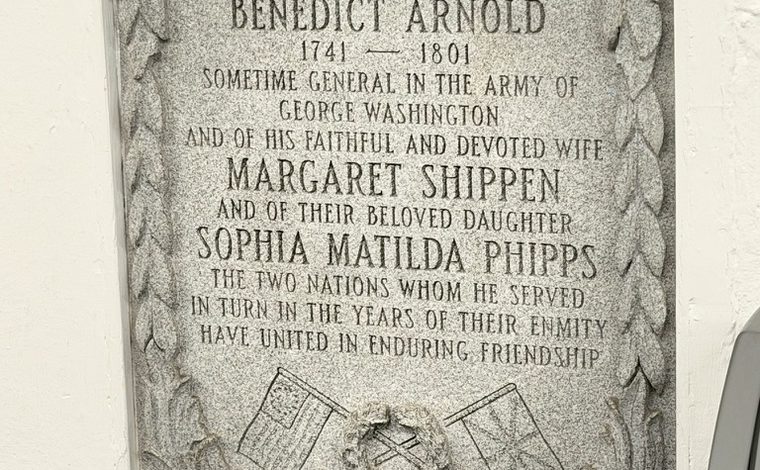
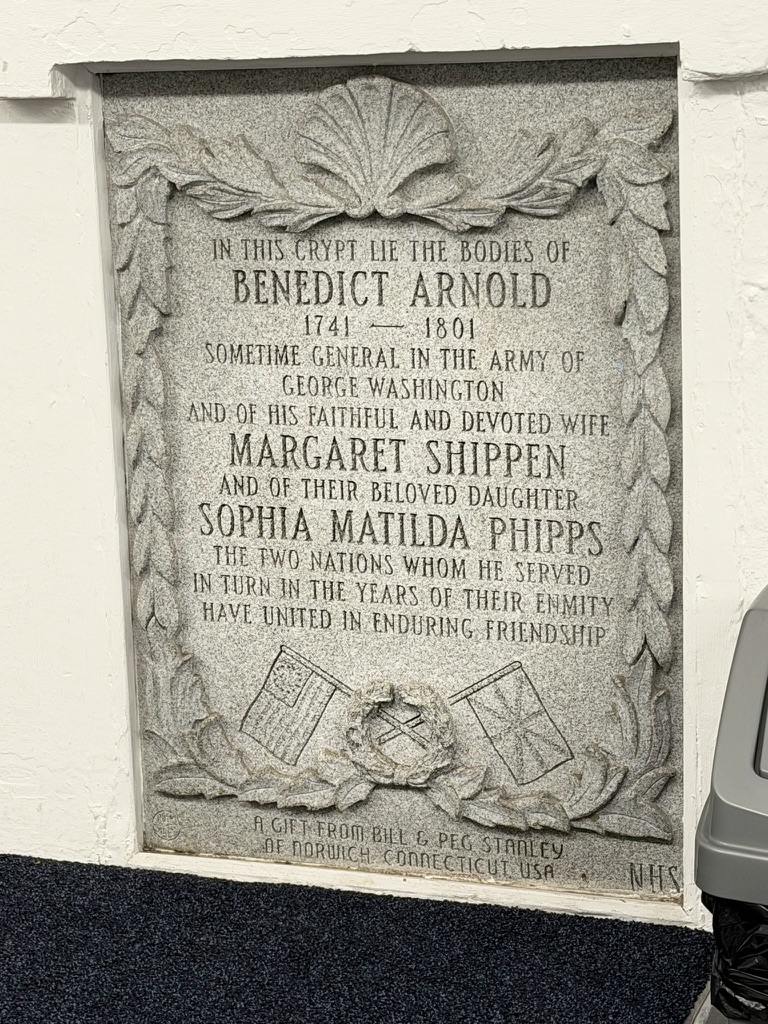 Visiting The Crypt of Benedict Arnold
Crypt of Benedict Arnold
 House where Freddie Mercury lived and died.
Last Seen / Disappearance Site in House where Freddie Mercury lived and died.
 John Reginald Christie and the Crimes of 10 Rillington Place
What Happened to 10 Rillington Place Because of the notoriety of the murd…
 Grenfell Tower Fire: A Tragedy That Changed Building Safety
Death / Incident Location in Grenfell Tower Fire: A Tragedy That Changed Building Safety
 Never Gonna Give You Up Filming Location
Filming / Pop Culture Location in Never Gonna Give You Up Filming Location
 Dennis Nilsen and 195 Melrose Ave.
Denis Nilsen – 195 Melrose Avenue
A place to stop
Flowers sit beneath the names on the Finsbury Square memorial in our photo. If you stop long enough to read them, you can pick out Jeffrey Benton and Bernard Marks among the 43. (Our memorial photograph)
The station plaque is a short walk from the square. One memorial names each of the people who died. The other sits at the station they were trying to reach that morning.
Inquiry, medical, and witness library
The documents include McNaughton’s inquiry, Fisher’s rescue account, and the medical teams’ reports. The interviews tell how survivors and crew members remembered the day.
The full 27-page PDF. Printed p. 1 covers the response; paragraphs 99–104 address causes; later paragraphs discuss protection.
Emergency Planning Digest, January–February 1976, pp. 14–22; PDF pp. 16–24. Primary operational account in an archive issue.
Part I, BMJ pp. 727–729: scene medical teams and communication. Published primary medical account.
Part II, BMJ pp. 729–731: injuries and treatment. Distinct from the operational paper.
Contemporaneous parliamentary statement; early casualty estimates were provisional.
A later first-person recollection, with its publication date identified.
Named firefighter accounts published by London Fire Brigade.
Historical safety lessons and automatic terminal protection.
Dated record of the Northern City Line’s later signalling change.
Official account of the Moor Place remembrance.
No matching records. Try another word.
Reader Notes
Add to the story.
Share a memory, correction, lead, or detail that helps the place come into focus.
Leave a note