
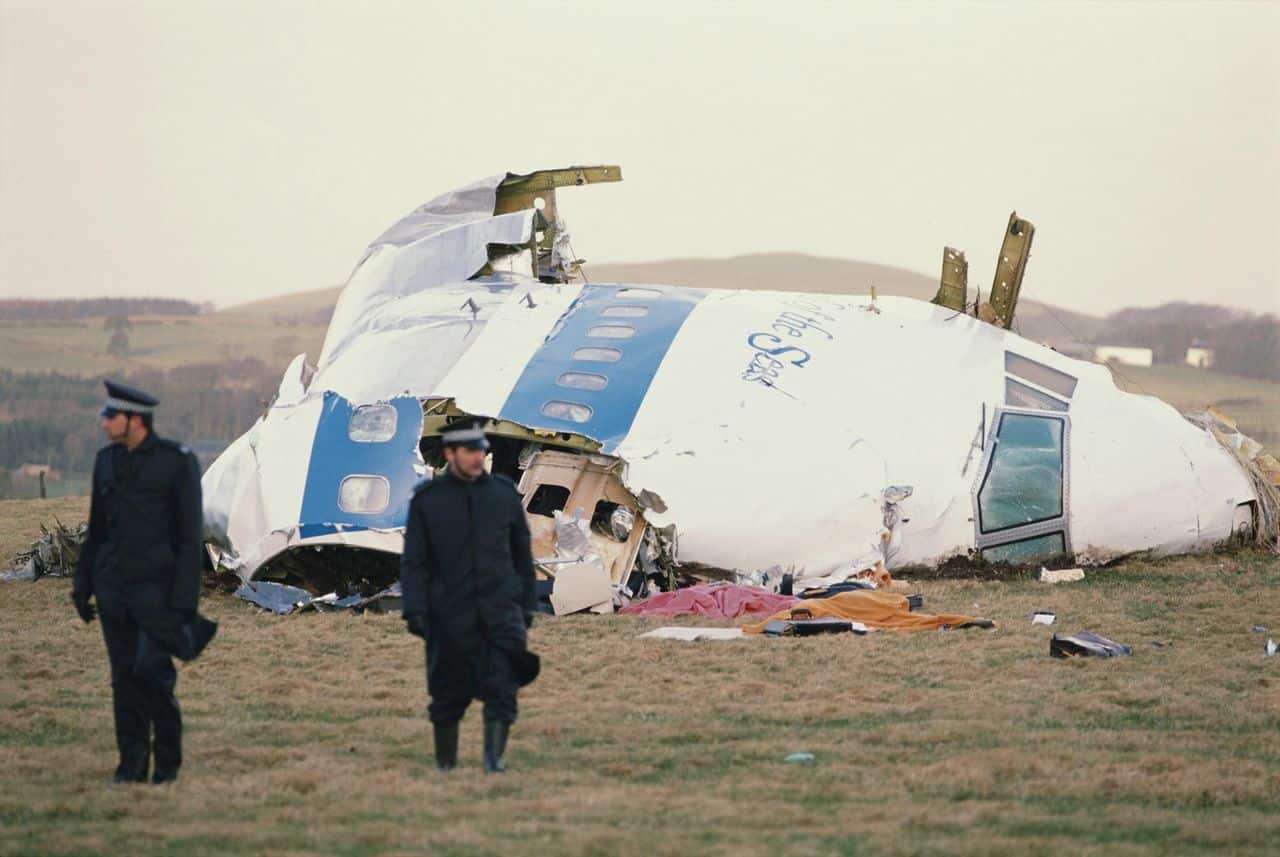
On December 21, 1988, a bomb destroyed Pan Am Flight 103 over Lockerbie, Scotland. All 243 passengers and sixteen crew members died, along with eleven people in their homes below. The aircraft’s destruction, the town’s response, and the lives of those 270 people remain inseparable from the long investigation and the court cases that followed. (AAIB, synopsis; secs. 1.1–1.4)
The departure from Heathrow
The Boeing 747 carried the name Clipper Maid of the Seas and the registration N739PA. On December 21 it arrived at Heathrow from San Francisco. Beside it stood a Boeing 727 bringing connecting passengers from Frankfurt. Those passengers and their luggage transferred to the larger aircraft for the New York flight; other travelers joined in London. (AAIB, sec. 1.1)
For thirty-five students studying abroad through Syracuse University, the journey followed a semester in London or Florence. Their return brought together ambitions that had been developing in studios, theaters, laboratories, and classrooms. The university later established scholarships and a permanent memorial in their names. (Syracuse University)
Captain James Bruce MacQuarrie had been flying for thirty-two years. His son Michael was also a Pan Am pilot; his daughter Pamela was a nurse. At home in New Hampshire he enjoyed restoring old cars and working on his colonial house. The family tribute remembers flying and family as the two great interests of his life. (James Bruce MacQuarrie)
At 6:04 p.m. the aircraft was pushed back from its stand. It took off at 6:25 and climbed north over England. By 6:56 it was level at 31,000 feet. The AAIB described the departure as unremarkable. These times are GMT, the local winter time in Britain. (AAIB, sec. 1.1; report time convention)
A radar return became falling wreckage
At 7:02:44 p.m., Shanwick Oceanic Control began transmitting the aircraft’s clearance for the Atlantic crossing. No acknowledgment came back. The flight recorders stopped at approximately 7:02:50; the single aircraft return disappeared from radar and was followed by multiple returns spreading downwind. (AAIB, secs. 1.9, 1.11)
The explosion began in a baggage container on the left side of the forward cargo hold, beneath the passenger cabin. Reconstructed wreckage showed a small, intensely shattered region in the lower fuselage, surrounded by outward-torn metal. Investigators distinguished that concentrated damage from the overload fractures caused by the wider breakup. (Trial judgment, paras. 4–6)
The AAIB found that the initial blast and the pressure effects traveling through spaces within the aircraft’s structure together destroyed the integrity of the forward fuselage. The nose and flight-deck section separated within two to three seconds. Much of the remaining aircraft broke apart during its descent. (AAIB, secs. 2.6–2.14; findings 3(a)(x)–(xiv))
The wings, engines, fuselage sections, luggage, and lighter fragments fell across the town and surrounding countryside. The flight that had left Heathrow only thirty-eight minutes earlier had become a disaster on the ground as well. (AAIB, secs. 1.1–1.4)
Eleven people were at home in Sherwood Crescent
The main wing structure struck Sherwood Crescent on Lockerbie’s southern edge. The impact left a crater approximately forty-seven metres long and produced a fireball that set neighboring houses alight. Across the damaged area, twenty-one homes ultimately had to be demolished and others needed major repairs. (AAIB, secs. 1.4, 1.12.1.1)
A long section of rear fuselage came down at Rosebank Crescent, just over six hundred metres from the crater. The flight deck and nose landed in a field near Tundergarth, east of the town. These were separate impact locations from the same airborne breakup, not one compact crash site. (AAIB, secs. 1.12.1.2–1.12.1.3)
The eleven Lockerbie residents who died belonged to five households: Kathleen, Thomas, and Joanne Flannigan; Dora and Maurice Henry; Mary Lancaster; Jean Murray; and John, Rosalind, Paul, and Lynsey Somerville. Their houses and their lives were part of the town before its name became known around the world. (Living Memorial)
Police, firefighters, medical staff, military personnel, and local volunteers responded. In later first-person interviews preserved by the FBI, responders describe the scale of recovery and the practical care residents gave to families. Clothes and other personal belongings were collected, cleaned, and returned. That work helped shape the FBI’s later approach to supporting victims of international crimes. (FBI)
Lives rooted in Lockerbie
Kathleen, Thomas, and Joanne Flannigan
Kathleen Mary Flannigan was forty-one, her husband Thomas forty-four, and their daughter Joanne ten. All three were at home in Sherwood Crescent. Their sons David and Steven were elsewhere and survived the bombing. The family’s memorial biography identifies Kathleen as a homemaker and Joanne as a schoolgirl. It remembers a family divided by who happened to be home that evening. (Kathleen Mary Flannigan)
Dora and Maurice Henry
Maurice Peter Henry came from Arranmore Island off Ireland’s northwest coast. As a teenager he moved to Scotland for work and spent years on drainage, dyking, and road construction around Dumfries. He married Dora Henrietta Moffat from Eskdalemuir. They bought 13 Sherwood Crescent and called it “Arranmore,” carrying his island’s name into their Scottish home. (Dora Henrietta Henry)
The family tribute remembers Maurice’s support for his church and the effect a serious car crash had on his health. Dora was fifty-six when she died. Their memorial account places them together at home on December 21. Neither body was recovered. (Dora Henrietta Henry)
John, Rosalind, Paul, and Lynsey Somerville
John Somerville, known as Jack, and Rosalind had grown up in Glasgow and married in East Kilbride, where Paul and Lynsey were born. Jack managed a large car showroom in Dumfries. His sister Janet Boyes recalled that the family had moved to Lockerbie about five years before the bombing and enjoyed its quieter life. (John Somerville)
Their baby son David, born in July 1988, had lived for only a day. After his death, Jack and Rosalind raised funds connected with cot-death support. In December the parents and both older children were killed together. Boyes’s tribute records a family comfort room at Dumfries Royal Infirmary dedicated to their memory. (John Somerville)
Mary Browell Lancaster
Mary was eighty-one. Born in Cumberland in January 1907, she married John Ernest Lancaster in January 1932 and had three children. Her husband died in 1961. Her memorial biography traces a life of marriage, children, and widowhood before recording her death at home in Sherwood Crescent. (Mary Browell Lancaster)
Jean Aitken Murray
Jean was eighty-two and lived at Westerley in Sherwood Crescent. She had worked as a seamstress at Lochmaben Hospital. Her memorial tribute identifies her family connections in Dumfries and remembers her as a sister and aunt. She was the oldest person killed in the bombing. (Jean Aitken Murray) (Living Memorial)
Work, study, and futures in progress
James Bruce MacQuarrie
The fifty-five-year-old captain had graduated from Peterborough High School, served in the U.S. Navy, and studied aeronautics at Boston University. He also served in the Massachusetts Air National Guard, reaching the rank of major. The memorial account places the professional pilot alongside the husband and father who spent time restoring vintage automobiles and caring for an old house. (James Bruce MacQuarrie)
Theodora Eugenia Cohen
Theo Cohen was twenty, the only child of Dan and Susan Cohen of Port Jervis, New York. She studied drama and voice at Syracuse. Summer-stock work had begun while she was still at school; in 1988 she played the lead in a Mac-Haydn Theatre production of The Fantasticks. In London she went to the theater frequently and planned an alternative theater company with fellow student Miriam Wolfe and friends. Both young women died aboard Flight 103. (Theodora Eugenia Cohen)
Alexia Kathryn Tsairis
Alexia, twenty, was studying photojournalism at Syracuse’s Newhouse School and had spent the autumn in London. She had already worked two summers in the Associated Press graphics and photography departments. Her parents, Peter and Aphrodite, and her mentor David Sutherland later established a photography foundation to support work advancing understanding and peace. The memorial biography connects her developing documentary eye with the opportunities subsequently created for other photographers. (Alexia Kathryn Tsairis)
Flora MacDonald Margaret Swire
Flora was traveling to the United States on the day before her twenty-fourth birthday. A Nottingham medical student with first-class honors, she had interrupted her clinical training to research brain waves for a doctorate. Her memorial account recalls her teaching herself computing and building equipment for that research. She also played piano and guitar, sang, sculpted, and had begun a novel. A memorial fund was established to help other medical students undertake doctoral research. (Flora Margaret MacDonald Swire)
The linked directory below leads to the names and individual memorial pages of all 270 people. (Living Memorial)
The investigation began with the wreckage
Search teams recovered and recorded tens of thousands of items. Aircraft sections were first examined at Longtown, then reconstructed at Farnborough. The investigation had to establish which damage came from an explosion, which from the aircraft breaking apart, and which from impact with the ground. (Trial judgment, paras. 3–6)
Container AVE 4041 was positioned in the forward hold beside the shattered lower-left fuselage. Its recovered panels showed an unusual combination of deformation, soot, and pitting. A neighboring container had damage consistent with blast emerging from AVE 4041. Those relationships allowed engineers and forensic scientists to locate the source within the luggage container. (Trial judgment, paras. 5–6)
Fragments of a brown hard-shell suitcase, clothing, and a Toshiba radio-cassette player formed the next part of the reconstruction. The trial judges accepted that the explosive device had been concealed in the player inside the suitcase. A small circuit-board fragment became evidence about the timer and its supply chain. (Trial judgment, paras. 7–16)
The AAIB’s work explained the aircraft’s destruction. It expressly left airport-security and criminal responsibility to separate investigations. Its safety recommendations concerned flight-recording systems and research into making aircraft structures and systems more tolerant of explosive damage. (AAIB, synopsis; sec. 4)
How damage in the forward hold broke the aircraft apart
Side view: the forward hold sits beneath the passenger cabin, ahead of the wing. The nose and flight deck separated early in the breakup.
Forward-hold cutaway: illustrative container and structure positions. Rust marks the region of initial blast damage.
The explosion began below the cabin
The AAIB and reconstructed evidence located the blast inside container AVE 4041 in the left forward hold. Damage to the container and nearby shell helped investigators distinguish the initial explosion from later breakup damage.
The damage spread beyond the first hole
The report describes direct explosive damage and pressure effects traveling through structural spaces. Together, these effects caused the forward fuselage to lose its integrity. The arrows indicate that mechanism, not a measured pressure path.
The nose separated within seconds
The forward fuselage and flight deck separated within two to three seconds. The remaining aircraft broke apart during descent, producing several major impact areas and a much wider trail of lighter wreckage.
The families also challenged Pan Am’s security
The civil litigation addressed an airline’s responsibility rather than the criminal identity of the bombers. A thirteen-week liability trial in New York ended on July 10, 1992, with a jury finding that Pan Am, including its security affiliate Alert, had engaged in wilful misconduct that was a substantial factor in the disaster. (Civil appeal, 1994, Background)
The dispute focused in part on unaccompanied baggage and the difference between X-ray screening and the physical checks required by the applicable security program. Pan Am contested both wilfulness and causation, arguing that its procedures were permissible and that the bag’s route could not be proved. (Civil appeal, 1994, Background; part I)
In the 1994 amended appellate opinion, the majority upheld liability but vacated specified damages awards and remanded those issues. Judge Van Graafeiland dissented over the fairness of the trial. The result was not a criminal conviction of airline staff, nor an appellate endorsement of every damages award. (Civil appeal, 1994, Conclusion and dissent)
A Scottish court in the Netherlands heard the murder case
British and U.S. authorities charged Abdelbaset al-Megrahi and Al Amin Khalifa Fhimah in 1991. The trial eventually took place at Camp Zeist in the Netherlands under Scots law, before three Scottish judges sitting without a jury. On January 31, 2001, the court convicted Megrahi of murder and acquitted Fhimah. (FBI) (Trial judgment, paras. 85–90)
The prosecution’s case combined the physical evidence with clothing bought at Mary’s House, a shop in Malta; the testimony of shopkeeper Tony Gauci; baggage records; Megrahi’s movements; and his connections with Libyan intelligence and the timer supplier. The judges accepted December 7, 1988, as the clothing-purchase date and placed Megrahi in Malta then. (Trial judgment, paras. 88–89)
Gauci’s identification was qualified: the judges explicitly described it as not unequivocal. They nevertheless accepted it as reliable when considered with the rest of the evidence. They also relied on Megrahi’s December 20–21 visit to Malta using a passport in the name Ahmed Khalifa Abdusamad. These were findings made by the trial court, not direct eyewitness observation of him placing a suitcase aboard a flight. (Trial judgment, paras. 87–89)
The court accepted the inference that the primary suitcase traveled from Malta through Frankfurt to Heathrow. It examined competing possibilities, including introduction in Frankfurt or London, and acknowledged uncertainties in the baggage evidence. Its conclusion depended on the combined pattern, rather than a recovered baggage tag establishing every transfer. (Trial judgment, paras. 31–39, 89)
The defense also raised Palestinian groups and individuals operating in Europe. The judges considered the PFLP-GC’s activities and radio-concealed devices but found the evidence did not create a reasonable doubt about the Libyan origin of this attack. They rejected a suggestion that passenger Khaled Jaafar had carried the bomb: the two holdalls attributed to him were recovered without explosion damage. (Trial judgment, paras. 72–82)
For Fhimah, the judges found insufficient corroborated evidence that he knowingly assisted an aircraft-bombing plan. Diary entries about obtaining luggage tags were not enough to establish the necessary knowledge and participation. His acquittal was a different result from Megrahi’s conviction. (Trial judgment, paras. 84–86)
Appeals, compensation, and compassionate release
Megrahi’s first appeal was refused on March 14, 2002. The appeal examined the trial court’s reasoning and further evidence, including the claimed significance of a break-in at Heathrow. The appellate court did not overturn the conviction. (Appeal, 2002, conclusions)
On August 15, 2003, Libya stated that it accepted responsibility for the actions of its officials and made arrangements for compensation to the victims’ families. U.S. Secretary of State Colin Powell’s statement recorded that formulation and distinguished the proposed lifting of U.N. sanctions from separate U.S. sanctions. State responsibility and compensation were separate from proving an individual defendant’s guilt. (Powell)
A further Scottish Criminal Cases Review Commission referral led to a second appeal process. Megrahi abandoned that appeal in August 2009. On August 20, Scottish ministers released him on compassionate grounds because of terminal prostate cancer; the prisoner-transfer application was refused. Compassionate release did not quash his conviction. (Release record) (Scottish Parliament)
Megrahi died in Libya in 2012. Following an application by his family, the commission referred the conviction again in March 2020. The posthumous appeal focused on the reasonableness of the verdict and material not disclosed to the defense, especially matters affecting Gauci’s identification. (Scottish Parliament) (Judiciary, 2021)
On January 15, 2021, the appeal judges refused the appeal. Their official summary explains that they assessed the identification in the context of the whole case and rejected the argument that the undisclosed material would have changed its preparation, presentation, or result. The Scottish Parliament’s 2025 account records that permission to appeal to the U.K. Supreme Court was refused in July 2022. (Judiciary, 2021) (Scottish Parliament)
The pending U.S. case against Mas’ud
U.S. authorities announced charges against Abu Agila Mohammad Mas’ud Kheir Al-Marimi in December 2020. He was taken into U.S. custody in 2022. Prosecutors allege that he built the explosive device. His case is separate from Megrahi’s Scottish conviction, and he has pleaded not guilty. (FBI) (U.S. case file)
One contested issue concerns a statement attributed to him during detention in Libya. The U.S. Attorney’s Office reported that, on August 6, 2026, the court denied suppression of portions of that statement and permitted their use in the government’s case. That is a ruling about admissibility, not a finding by a trial jury that the account is true or that the defendant is guilty. (Status update, Aug. 2026)
Jury selection expected in August was postponed after newly disclosed evidence. A September status hearing addressed a revised schedule. Judge Dabney Friedrich’s October 7 pretrial order then set jury selection for January 19, 2027, at 9:30 a.m. in Courtroom 24 in Washington, D.C. The order also provided for further suppression and evidentiary motions. (Status update, Sept. 2026) (Pretrial order, 2026, paras. 1, 7)
Status checked November 17, 2026: the U.S. prosecution remains pending. The January date is a scheduled start, not a completed trial or verdict. Megrahi’s conviction continues to stand, and Fhimah’s 2001 acquittal remains a separate legal outcome. (U.S. case file) (Pretrial order, 2026) (Scottish Parliament)
What each part of the record establishes
Explosion origin
Record. Concentrated shattering, soot, and pitting were found in the lower-left forward fuselage and container AVE 4041.
Interpretation and finding. The court accepted an internal explosion within the baggage container. This finding locates the blast; it does not by itself identify who introduced the bag. (Trial judgment, paras. 4–6)
Suitcase and radio fragments
Record. Fragments of a hard-shell suitcase, clothing, and a Toshiba radio-cassette player were examined together.
Interpretation and finding. The judges accepted a radio concealed in the primary suitcase. The inference came from forensic relationships among fragments, not an intact device. (Trial judgment, paras. 7–16)
Clothing from Malta
Record. Labels and shop evidence traced items around the device to Mary’s House in Malta.
Interpretation and finding. The court accepted the clothing link. The further questions were who bought it and when. (Trial judgment, paras. 12–28)
Tony Gauci’s identification
Record. Gauci gave resemblance identification evidence rather than an unequivocal identification.
Interpretation and finding. The trial accepted it in the whole evidential context. Its reliability and the effect of undisclosed material were central to the 2021 appeal, which failed. (Trial judgment, paras. 88–89)
Purchase date
Record. The trial found that the clothes were bought on December 7, 1988, when Megrahi was in Malta.
Interpretation and finding. The date was part of the inferential case; it was not simply assumed from his presence. The defense challenged the chronology. (Trial judgment, paras. 20–28, 88)
Timer fragment
Record. A small circuit-board fragment was compared with MEBO MST-13 timers and evidence of their supply.
Interpretation and finding. The trial accepted the timer connection. Evidence about a type and its distribution must be distinguished from direct observation of this device’s assembly. (Trial judgment, paras. 35–49)
The baggage route
Record. The prosecution relied on airport records, handling evidence, and the circumstances of the Malta flight.
Interpretation and finding. The court accepted Malta–Frankfurt–Heathrow as the route while recognizing uncertainties. Introduction at Heathrow or Frankfurt was a contested alternative. (Trial judgment, paras. 31–39, 89)
The coded passport
Record. Megrahi used the name Ahmed Khalifa Abdusamad for his December 20–21 Malta visit.
Interpretation and finding. The court treated the unexplained visit as part of the combined case, not as a standalone eyewitness account of placing the bomb. (Trial judgment, paras. 87–89)
Fhimah’s diary
Record. Entries referred to obtaining luggage tags.
Interpretation and finding. The judges found insufficient corroboration of knowing participation in the bombing and acquitted him. (Trial judgment, paras. 84–86)
PFLP-GC and alternative suspects
Record. The defense raised another group’s radio-concealed explosive devices and activities.
Interpretation and finding. The judges found the alternative evidence did not create reasonable doubt in this prosecution. Their conclusion should not be replaced by an unqualified claim that every historical theory has been proved or disproved. (Trial judgment, paras. 72–82)
Pan Am’s civil liability
Record. A jury found wilful misconduct and a substantial causal contribution.
Interpretation and finding. The appellate majority affirmed liability, remanding specified damages issues; a judge dissented. This is a civil result, distinct from the murder verdict. (Civil appeal, 1994, Conclusion)
Mas’ud’s attributed statement
Record. The prosecution seeks to use a statement made during detention in Libya.
Interpretation and finding. The August 2026 admissibility ruling did not resolve trial guilt. The October order allowed further litigation over statements. (Status update, Aug. 2026, status update)
No matching evidence topics.
Lockerbie’s places of remembrance
The map retains our two original photo-location points. They mark the Sherwood Crescent memorial and Dryfesdale Cemetery stop, rather than measured aircraft impact points. Our photographs and the native map, directions, nearby-location, and trip tools remain together below. (Our photographs)
Sherwood Crescent memorial garden
Sherwood Crescent, Lockerbie, DG11 2DY
Our original point is 55.1154532, -3.3585146. The garden commemorates people killed in this residential street. It is a remembrance stop within a living neighborhood; the pin is not a surveyed crater boundary. (Our photographs)
Garden of Remembrance
Dryfesdale Cemetery, Dumfries Road, Lockerbie, DG11 1HZ
Our original point is 55.1176889, -3.377512. IWM describes the memorial tablets, individual and group plaques, and the surrounding garden. The adjacent Lodge is a distinct visitor centre. (IWM memorial record)
Rosebank Crescent
Lockerbie; historical impact location
The AAIB records the large rear-fuselage section here, just over 600 metres from the main crater. Private homes remain private; this atlas supplies historical context rather than access to a property. (AAIB)
Tundergarth
Countryside east of Lockerbie; nose-section recovery area
The forward fuselage and flight deck were recovered near Tundergarth. The field shown in the historic photograph and the place of the explosion in flight are different locations. (AAIB)
Heathrow Airport
London; departure point for the Boeing 747
Passengers and baggage transferred from other services here. Frankfurt and Malta also figure in the criminal court’s reconstruction of the bag’s journey; that evidential route is not drawn as an observed personal itinerary. (Trial judgment)
Our photographs at Sherwood Crescent
Our January 2024 photographs show the small garden within the rebuilt neighborhood. A stone, planted beds, and a lawn now occupy a place associated with destroyed homes. The historical aerial photograph above and these later ground-level views record different moments in the street’s history. (Our photographs)
Remembering the eleven residents here means remembering more than the impact. The Henrys’ house name linked Scotland to Arranmore. The Somervilles had come for a quieter life. The Flannigans’ ten-year-old daughter was at home with her parents. The memorial belongs to that local history as well as to the international story. (Dora Henrietta Henry) (John Somerville) (Kathleen Mary Flannigan)





The names at Dryfesdale
The Garden of Remembrance in Dryfesdale Cemetery brings together the names of all 270 victims. Its main memorial has three stone tablets; around the garden are individual and group tributes. Our photographs show both the collective inscription and smaller plaques added by families, friends, and institutions. (IWM memorial record) (Our photographs)
Dryfesdale Lodge, beside the cemetery, describes its purpose as honoring the dead and the lasting connections between Lockerbie and communities abroad. The garden, the Lodge, and the individual plaques are related places of remembrance, with different roles. (Dryfesdale Lodge)
Across the Atlantic, Arlington’s memorial cairn is built from 270 blocks of red Scottish sandstone, a gift from Scotland. Syracuse’s Place of Remembrance bears the names of its thirty-five lost students. The memorials connect places without erasing the individual names. (Arlington) (Syracuse University)


The 270 names
This directory follows the Living Memorial’s names and links to each individual memorial page. The profiles include passengers, crew, and the eleven Lockerbie residents. (Living Memorial)
Open the complete memorial directory
- John Ahern
- Sarah Aicher
- John Akerstrom
- Ronald Alexander
- Thomas Ammerman
- Martin Apfelbaum
- Rachel Asrelsky
- Judith Atkinson
- Elisabeth Avoyne
- Jerry Avritt
- Clare Bacciochi
- Harry Bainbridge
- Stuart Barclay
- Jean Bell
- Julian Benello
- Lawrence Bennett
- Philip Bergstrom
- Alistair Berkley
- Michael Bernstein
- Steven Berrell
- Noelle Berti
- Surinder Bhatia
- Kenneth Bissett
- Diane Boatmon-Fuller
- Stephen Boland
- Glenn Bouckley
- Paula Alderman Bouckley
- Nicole Boulanger
- Francis Boyer
- Nicholas Bright
- Daniel Solomon Browner
- Colleen Brunner
- Timothy Burman
- Michael Buser
- Warren Buser
- Steven Butler
- William Cadman
- Hernán Caffarone
- Fabiana Benvenuto De Caffarone
- Valerie Canady
- Gregory Capasso
- Timothy Cardwell
- Bernt Carlsson
- Richard Cawley
- Frank Ciulla
- Theodora Cohen
- Jason Coker
- Eric Coker
- Gary Colasanti
- Bridget Concannon
- Sean Concannon
- Thomas Concannon
- Tracey Corner
- Scott Cory
- Willis Coursey
- Patricia Coyle
- John Cummock
- Joseph Curry
- William Daniels
- Gretchen Dater
- Shannon Davis
- Gabriele Dellaripa
- Peter Dix
- Om Dixit
- Shanti Dixit
- David Dornstein
- Michael Doyle
- Siv Engstrom
- Turhan Ergin
- Kathleen Flannigan
- Thomas Flannigan
- Joanne Flannigan
- Clayton Flick
- John Flynn
- Arthur Fondiler
- Robert Fortune
- Stacie Franklin
- Paul Freeman
- James Fuller
- Ibolya Gabor
- Amy Gallagher
- Matthew Gannon
- Kenneth Garczynski
- Paul Garrett
- Kenneth Gibson
- Andrew Gillies-Wright
- Olive Gordon
- Anne Gorgacz
- Loretta Gorgacz
- Linda Gorgacz-Gordon
- David Gould
- André Guevorgian
- Nicola Hall
- Lorraine Buser Halsch
- Lynne Hartunian
- Anthony Hawkins
- Dora Henry
- Maurice Henry
- Pamela Herbert
- Rodney Hilbert
- Alfred Hill
- Katharine Hollister
- Melina Hudson
- Josephine Hudson
- Sophie Hudson
- Karen Hunt
- Roger Hurst
- William Atkinson III
- Edgar Eggleston III
- Charles Fisher IV
- Elizabeth Ivell
- Khaled Jaafar
- Robert Jeck
- Paul Jeffreys
- Rachel Jeffreys
- Kathleen Jermyn
- Beth Johnson
- Mary Johnson
- Timothy Johnson
- Christopher Jones
- William Giebler Jr.
- Joe Nathan Woods Jr.
- Julianne Kelly
- Jay Kingham
- Patricia Klein
- Gregory Kosmowski
- Elke Kuehne
- Minas Kulukundis
- Mary Lancaster
- Ronald Lariviere
- Maria De Larracoechea
- Robert Leckburg
- William Leyrer
- Wendy Lincoln
- Alexander Lowenstein
- Lloyd Ludlow
- Maria Lürbke
- William MacAllister
- Lilibeth MacAlolooy
- William Mack
- James MacQuarrie
- Douglas Malicote
- Wendy Malicote
- Elizabeth Marek
- Louis Marengo
- Noel Martin
- Diane Maslowski
- Joyce Di Mauro
- Daniel McCarthy
- Robert McCollum
- Charles McKee
- Bernard McLaughlin
- Jane Melber
- John Merrill
- Suzanne Miazga
- Joseph Miller
- Jewel Mitchell
- Richard Monetti
- Jane Morgan
- Eva Morson
- Helga Mosey
- John Mulroy
- Sean Mulroy
- Ingrid Mulroy-Svensson
- Mary Murphy
- Jean Murray
- Gianfranca Di Nardo
- Karen Noonan
- Daniel O'Connor
- Mary O'Neill
- Anne Otenasek
- Bryony Owen
- Gwyneth Owen
- Laura Owens
- Martha Owens
- Robert Owens
- Sarah Owens
- Robert Pagnucco
- Christos Papadopoulos
- Peter Peirce
- Michael Pescatore
- Sarah Philipps
- Frederick Phillips
- James Pitt
- David Platt
- Walter Porter
- Pamela Posen
- William Pugh
- Estrella Quiguyan
- Rajesh Ramses
- Anmol Rattan
- Garima Rattan
- Suruchi Rattan
- Anita Reeves
- Mark Rein
- Jocelyn Reina
- Diane Rencevicz
- Louise Rogers
- Edina Roller
- Janos Roller
- Zsuzsana Roller
- Hanne Root
- Saul Rosen
- Andrea Rosenthal
- Daniel Rosenthal
- Myra Royal
- Arnaud Rubin
- Elyse Saraceni
- Theresa Saunders
- Scott Saunders
- Johannes Schauble
- Robert Schlageter
- Thomas Schultz
- Sally Scott
- Amy Shapiro
- Mridula Shastri
- Joanna Sheanshang
- Irving Sigal
- Martin Simpson
- Irja Skabo
- Ingrid Smith
- James Smith
- Mary Smith
- Cynthia Smith
- John Somerville
- Rosalind Somerville
- Paul Somerville
- Lynsey Somerville
- Rachael Stevenson
- Geraldine Stevenson
- Hannah Stevenson
- John Stevenson
- Charlotte Stinnett
- Michael Stinnett
- Stacey Stinnett
- James Stow
- Elia Stratis
- Anthony Swan
- Flora Swire
- Marc Tager
- Hidekazu Tanaka
- Andrew Teran
- Arva Thomas
- Jonathan Thomas
- Lawanda Thomas
- Tomas Floro Van Tienhoven
- Mark Tobin
- David Trimmer-Smith
- Alexia Tsairis
- Barry Valentino
- Asaad Vejdany
- Milutin Velimirovich
- Nicholas Vrenios
- Peter Vulcu
- Raymond Wagner
- Janina Waido
- Thomas Walker
- Kesha Weedon
- Jerome Weston
- Jonathan White
- Bonnie Williams
- Brittany Williams
- Eric Williams
- Stephanie Williams
- George Williams
- Miriam Wolfe
- Chelsea Marie Woods
- Dedera Woods
- Joe Woods
- Mark Zwynenburg
Read the reports, judgments, and filings
Complete official technical report. Flight history, wreckage reconstruction, breakup analysis, findings, and safety recommendations.
Official photographs and diagrams, including the forward structure and wreckage distribution.
Full 82-page opinion; findings, evidential qualifications, Megrahi’s conviction, and Fhimah’s acquittal.
Full appellate opinion. Read alongside the trial judgment.
The judiciary’s official explanatory summary; identified as a summary rather than the full opinion.
Majority opinion and dissent; liability result and distinct damages remands.
Prosecutors’ published account of evidentiary rulings, not a jury verdict.
Signed court order setting January 19, 2027 jury selection and additional pretrial deadlines.
Filings, orders, and family-information updates; distinguish a party’s motion from a court ruling.
Collection description and access information, including some restricted personal material.
No matching records.
A town, and the lives it continues to remember
The story continues in courtrooms, archives, and families’ efforts to preserve names and work. Syracuse’s archive began in 1990 and later expanded its scope to all 270 victims. It holds personal material as well as documents about the investigation and trials. (Syracuse archives)
In our photographs, Sherwood Crescent is a neighborhood again, with houses beside the memorial garden. At Dryfesdale, the collective names and the individual plaques stand together. A photograph, a family memory, a theater ambition, a research project, or the name given to a home restores something the total alone cannot convey. (Our photographs)
The evidence explains how an aircraft was destroyed and how responsibility has been argued and judged. The memorials return the story to the people: those traveling home, those working the flight, and those who were already home in Lockerbie.
Reader Notes
Add to the story.
Share a memory, correction, lead, or detail that helps the place come into focus.
Leave a note