
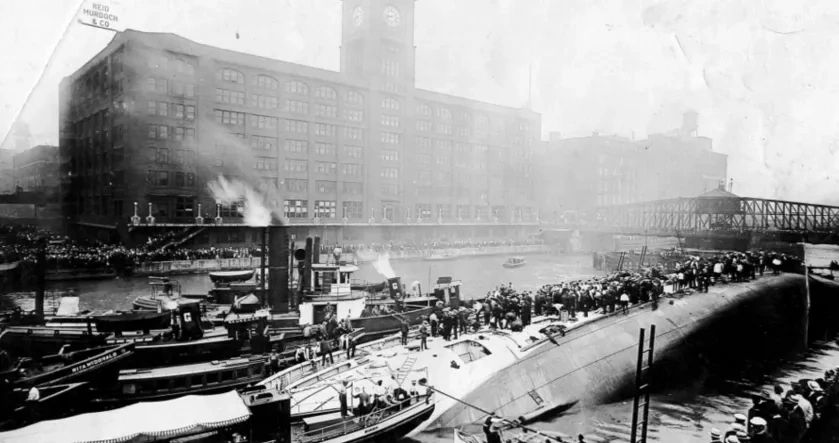
On July 24, 1915, Western Electric employees and their families boarded the Eastland for a picnic in Michigan City, Indiana. The ship was still tied up just west of Chicago’s Clark Street Bridge when it rolled onto its side. The count most often given is 844 dead. Investigators agreed the ship had become unstable, but they offered different explanations for what set off the roll. (Cook County coroner’s verdict; 1915 city count; Eastland Disaster Historical Society)
A Saturday outing for the Hawthorne Works
Many employees at Western Electric’s Hawthorne Works in Cicero worked six days a week. The picnic was a day off with family and coworkers at Washington Park, where they could spend time by Lake Michigan. Five steamers were chartered for the trip, including the Eastland. (Eastland Disaster Historical Society)
Boarding began around 6:30 a.m. The Eastland’s certificate allowed 2,500 passengers and 70 crew. More than 7,000 tickets had been sold for the outing across all five boats. (Department of Commerce hearing record; coroner’s verdict; EDHS)
The ship was still at the dock after 7 a.m. Fred Snow, who tended the bridge, told the coroner’s jury that he saw it lean toward the river around 7:15. It righted itself partway, then leaned again. Snow estimated that it went over about two minutes later. (Snow testimony)
Around 7:30, the Eastland came to rest on its port side in shallow water, with part of the hull above the surface. It had never left the dock. The coroner’s verdict placed it immediately west of Clark Street Bridge and attributed the deaths to drowning. (coroner’s verdict; National Archives case description)
The people aboard
Employees brought spouses, children, and other relatives. A week after the disaster, the Chicago Herald printed a memorial edition with names and photographs. You can read it through Newberry Library and look up individual families in the Eastland Disaster Historical Society collection. (Chicago Herald memorial edition; EDHS people database)
Charles Trogg, 46, and his wife Catherine, 31, went with Catherine’s brother Tony Serouka. Charles had worked at Western Electric for nine years. All three died. The Troggs’ children, Eveline and Walter, were five and three. The Historical Society of Forest Park says Charles and Catherine were found together and buried on July 27 at Concordia Cemetery. (Forest Park Historical Society)
Herbert Buelow grew up in Little Village and invited his cousin Ralph Rossow along. Both died. Herbert had been at Western Electric just over two years. His younger brothers later went to work there, too. (Forest Park Historical Society)
The memorial edition and the historical society list the people who died by name. The figure most often cited today is 844 passengers and crew. A Chicago city manual published that year gave a revised count of 812 based on the coroner’s figures. (Chicago City Manual; Herald memorial edition; EDHS)
Why the ship lost its balance
Investigators examined how the ship had been built, loaded, and operated. They asked how much water was in the ballast tanks and whether the hull could have touched the riverbed. The coroner’s jury found that passengers’ ordinary movements were no cause for blame. It recommended that a grand jury consider manslaughter charges against six people. (Cook County coroner’s verdict)
Naval architect W. J. Wood called the Eastland “cranky.” He explained that water in tanks low in the ship could make it steadier. He thought the tanks were empty or had too little water. One possibility he raised was that the loaded ship touched bottom before passengers moved toward the river side. If it stayed afloat, he said the shape of the hull and the weight on that side might explain the list. He offered those ideas without having tested the ship. (Wood testimony)
Chief engineer Joseph Erickson wrote that the ballast tanks had been pumped out before boarding. He described how the crew worked the valves and pumps after the ship began to lean. A grand jury later blamed instability as the ship took on passengers and raised overloading, ballast handling, and construction as possible contributing factors. (Erickson letter and Board record; grand jury report reproduced in the Congressional Record)
The rescue and the inquiries
People could reach the exposed hull from the bank and from boats. Firefighters, police, sailors, river workers, and bystanders helped search for survivors. The coroner’s jury heard from people who saw the ship go over and people who had been working aboard. (coroner’s inquest transcript and verdict)
The federal Board of Inquiry collected testimony in 1915. It prepared a preliminary report for the Secretary of Commerce and put decisions about officers and inspectors on hold during the criminal proceedings. The House published the testimony and report in 1916. (Board of Inquiry hearing and preliminary report; Congressional Record)
In February 1916, Judge Charles W. Sessions refused to send the federal defendants from Michigan to Illinois for trial. He ruled that the Chicago River site was outside the high seas and Great Lakes jurisdiction of the law used in the indictments. He also found no probable cause under those indictments. (Sessions, federal removal decision; National Archives case description)
Work to raise the Eastland began in August 1915. After repairs, the former excursion boat served the U.S. Navy as the USS Wilmette. (Newberry Eastland collection; National Archives)
What the record establishes
Passenger certificate and loading
Record. An amended certificate dated June 7, 1915, allowed 2,500 passengers and 70 crew. The picnic history reports boarding began about 6:30 a.m. and the vessel approached that passenger capacity.
Interpretation in the record. The Cook County jury considered loading as one possible contributor to the disaster.
Alternative or limit. A permitted maximum does not itself establish the actual count aboard at the moment of the capsize or prove that the certificate limit was exceeded.
Status. The certificate limit and loading context are documented; they do not independently identify the physical trigger. (Department of Commerce; coroner’s verdict)
Witness observations of the list
Record. Bridge tender Fred Snow described a riverward list at roughly 7:15, some recovery, then a renewed list and overturning within minutes.
Interpretation. His testimony places a developing list before the ship rolled.
Alternative or limit. His time is an estimate from an eyewitness and does not establish what internal condition caused the movement.
Status. Supports a sequence of listing and capsize; not a determination of cause. (Snow testimony)
Double-bottom tanks and ballast
Record. Naval architect W. J. Wood described water ballast low in the hull and testified to his belief the tanks were empty or underfilled. Chief engineer Erickson’s letter described pumping and valve operations.
Interpretation. Wood regarded low ballast as stabilizing weight and discussed inadequate ballast as relevant.
Alternative or limit. Wood said his view rested on assumptions and he had not experimentally tested the vessel’s stability. Erickson supplied his own account, which did not settle the physical cause.
Status. Both are testimony in an inquiry; neither is a final measured reconstruction. (Wood testimony; Erickson letter)
Possible grounding in shallow water
Record. Wood raised the possibility that the loaded ship’s draft increased enough for it to ground, after which passenger movement might have affected its balance.
Interpretation. This was one proposed sequence that could help explain a sudden change in stability.
Alternative or limit. Wood also gave a different possibility if the vessel had not grounded. The coroner record does not establish grounding as fact.
Status. A contemporaneous theory, not an established finding. (Wood testimony)
Different official conclusions and legal outcome
Record. The coroner’s jury rejected ordinary passenger behavior as a cause and recommended further consideration of six people. The grand jury listed loading, ballast and construction as possible factors. Judge Sessions later denied federal removal under the cited statute.
Interpretation. The inquest and grand jury addressed responsibility and possible causes; the federal judge addressed jurisdiction and probable cause for removal.
Alternative or limit. The removal ruling was not a trial on physical cause and not a jury verdict on the merits.
Status. No single one of these records establishes one exclusive technical trigger or a criminal conviction in a Chicago trial. (coroner’s verdict; grand jury report; Sessions decision)
No matching record topics.
Location atlas
Where the Eastland went over
South side of the Chicago River, immediately west of Clark Street Bridge, Chicago
The coroner’s verdict puts the ship beside the south bank just west of Clark Street Bridge. (Cook County coroner’s verdict)
The marker on Wacker Drive
144 W. Wacker Drive, Chicago, Illinois 60601 · 41.8869456, ?87.6324253
The map points to the marker and the riverfront where we took our photo.
Hawthorne Works
Cicero, Illinois, in the Hawthorne Works district
Western Electric employees came from this plant for the company outing. (EDHS picnic history)
Washington Park picnic destination
Michigan City, Indiana · Lake Michigan shore
Washington Park was where the passengers planned to spend the day. (EDHS picnic history)
The riverfront today
Our photograph looks out over the Chicago River from Wacker Drive. The marker is near the spot where the Eastland was tied up.
The excursion advertisement, rescue images, and marker photos show the riverfront story in different years. Both rescue images carry an Eye Film watermark.
Read the source records
The Cook County inquest records what witnesses and experts told the coroner’s jury. The House volume prints the federal inquiry and its preliminary report.
Primary documents and reference collections · 7 records
A city remembers its neighbors
By July 31, the Chicago Herald had names and photographs to print beside the news of the disaster. The family histories tell a smaller story. Herbert asked his cousin to come along. Charles and Catherine were going to spend the day away from work. The marker beside the river is close to where those plans ended.
Works Cited · 12 sources



Cases near this location
Showing cases with mapped locations within 50 miles of this stop.
 Three Boys, One Tragedy: The 1955 Chicago Murders That Shocked a City
Loop theater then and more recently. We had to use a Google Maps photo of…
 Shame at the Diamond: The 1919 Black Sox Scandal
Grave / Memorial in Shame at the Diamond: The 1919 Black Sox Scandal
 When Toys Turn Deadly: The Enduring Terror of Child's Play
Filming / Pop Culture Location in When Toys Turn Deadly: The Enduring Terror of Child's Play
 The Night Richard Speck Murdered Eight Nurses in Chicago (July 13–14, 1966)
Built in 1882 as a luxury apartment building, the structure's distinctive…
 The Fall of Chicago's Most Feared Gangster: The Death of Hymie Weiss
Crime Scene in The Fall of Chicago's Most Feared Gangster: The Death of Hymie Weiss
 Married With Children
Married with Children fountain from opening credits
 John Wayne Gacy and Timothy McCoy: A Tragic Encounter at a Chicago Bus Terminal
Greyhound Bus Station where John Wayne Gacy picked up Timothy McCoy
 Al Capone's Valentine: A Massacre That Shocked the World
The original building no longer exists. By 1967, the site at 2122 N. Clar…
 The Violent Death of John Dillinger
Spot John Dillinger was killed
 Tragic Collision: The Impact of Chicago's 1972 Train Crash
Crash / Disaster Site in Tragic Collision: The Impact of Chicago's 1972 Train Crash
 Shaking off tragedy, Our Lady of the Angels Church
The original school building that was destroyed in the fire was completel…
 The crime that changed Chicago: The tragic death of Barbara and Patricia Grimes
Grimes family home.
Reader Notes
Add to the story.
Share a memory, correction, lead, or detail that helps the place come into focus.
Leave a note